2 / 6 · Observe one card
2 / 6
Observe one card
Leave the keywords aside for a moment. Look closely before using reference material. You do not have to understand the image immediately; start with details you can check.

Start with the distinction
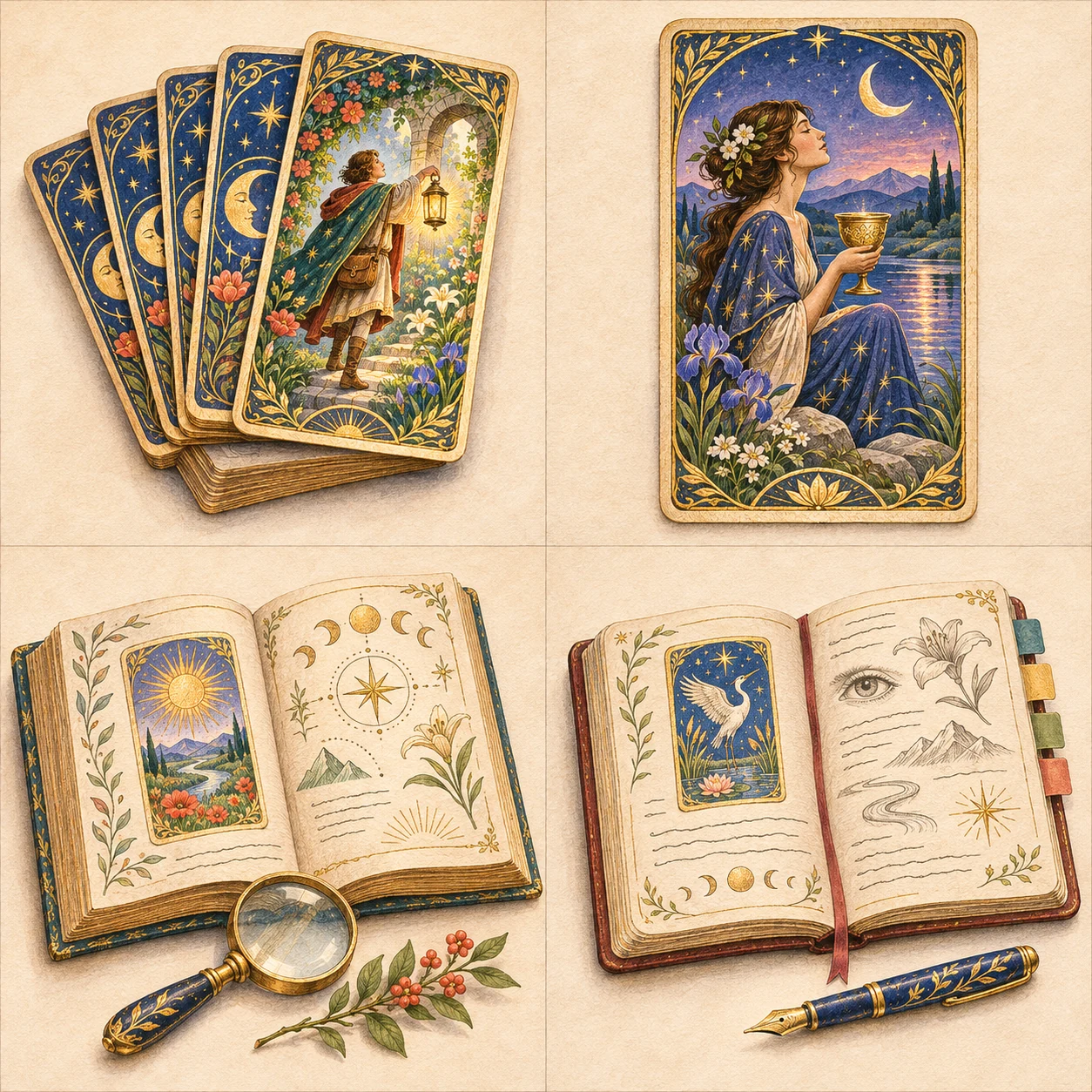
Observation describes an image: a person holds a gold cup, a moon appears above, and mountains and water lie in the distance. Interpretation is the understanding you form: the cup suggests receiving, while water suggests movement. Both matter, but they are different kinds of evidence.
The same detail can suggest different things. A seated figure may evoke rest or waiting. Check the image first, then consider your question. When the image does not supply information, you can simply write ‘I do not know.’
Three steps to try
Write three details you can point to
What is the person doing? Where are the objects? Compare colour, direction and distance. Avoid words such as ‘happy’ or ‘dangerous’ when they already imply a judgment.
Find a basis for each association
Write ‘Because I see …, I associate it with …’. If you cannot identify a corresponding detail, keep the association in a separate column for your own thoughts.
Leave a line for what is unknown
An image cannot establish someone’s real motives or guarantee the next event. Record what would need real-world information to answer.
Compare two approaches
She holds a gold cup, so good news is certain.
Describe first, interpret second, then check how far the interpretation has gone. Images can prompt ideas without proving real events.
Try the Moonlit Cup teaching image
First note that the figure holds a cup, water is nearby and a moon is in the sky. Then write an association: ‘This scene suggests quietly identifying my feelings.’ If your question concerns expressing a need, ask, ‘Which feeling could I name first?’ Do not leap from this to ‘My friend will certainly understand.’

Try it for yourself
Look at the teaching image on this page. Record three details, one association and one question the image has not answered. Then compare your notes with reference material and see what it adds.
Your text stays on this page. Refreshing or leaving clears it; nothing is sent or saved to your account.
Say what you see before explaining how you understand it.
 Continue learning →
Exercises and interpretations are for learning and reflection and do not constitute professional advice.