5 / 6 · Read cards together
5 / 6
Read cards together
Reading cards together does not mean joining keywords into a prediction. Observe each one, then look for similarities, contrasts and things that do not yet connect.

Start with the distinction
Images may echo each other through colour, direction, objects or actions. If one seems still and another suggests movement, you could explore the relationship between pausing to notice and taking action. That connection remains an interpretation.
When two cards evoke different feelings, you need not force agreement. Try ‘On one hand …, on the other …’. Return to the question and consider whether the positions are exploring different aspects in the first place.
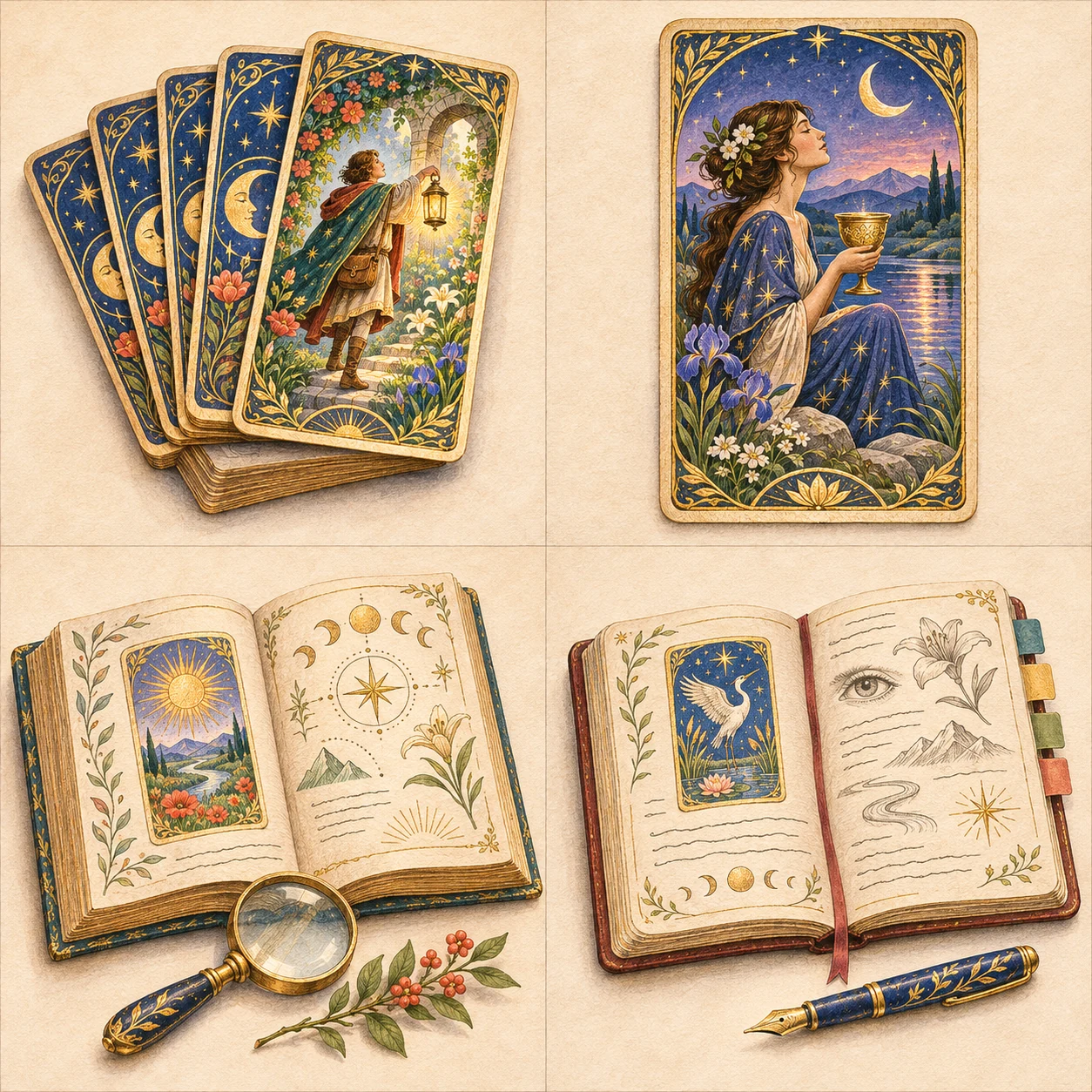
Three steps to try
Describe each card separately
Cover the other cards for a moment. Give each image its own observation instead of deciding on a story and selecting evidence to fit.
Find one similarity or difference
Choose a connection you can point to: repeated colours, the direction figures face, or relationships of near and far.
Connect with qualified language
Use ‘It suggests to me,’ ‘I could explore’ and ‘I still need to check.’ Turn the interpretation into a small real-world action.
Compare two approaches
These two cards appeared, so things must develop as I expect.
An evidence-based connection can support understanding. A smooth story is not proof of its conclusion.
From staying still to setting out
One image draws your attention to staying; another to moving forward. You might read them as ‘Perhaps I need to understand my hesitation before deciding whether to take a step.’ Then check whether you lack information, energy or support. Do not turn ‘setting out’ into an instruction to act immediately.

Try it for yourself
Write an observation for each of two images, one similarity and one difference. Then write up to three sentences beginning ‘This suggests to me …’, keeping at least one unresolved question.
Your text stays on this page. Refreshing or leaving clears it; nothing is sent or saved to your account.
Let images speak to one another without requiring them to say the same thing.
 Continue learning →
Exercises and interpretations are for learning and reflection and do not constitute professional advice.